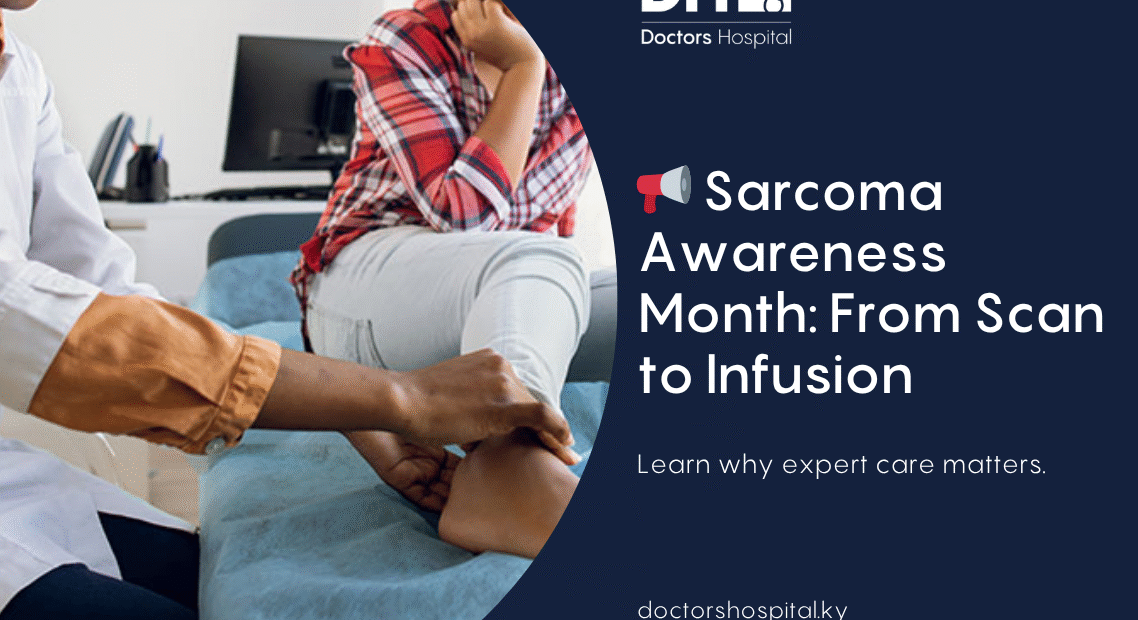
July Is Sarcoma Awareness Month: Why Expert Care Matters – From First Scan to Final Infusion
Written by Dr. Natalie Sharpe, Medical Oncologist
Sarcoma and bone cancers are rare but serious diseases that begin in connective tissues such as bone, muscle, fat, and nerves. Although they represent only a small fraction of all cancer diagnoses, their impact—especially on children and young adults—is profound.
With more than 70 different types of sarcomas and often subtle early symptoms, increasing public awareness is essential to improving early diagnosis and driving global research.
It Often Starts Quietly
A persistent sore knee. A lump in the thigh. A pain that just won’t go away. For many sarcoma patients, their journey begins not in an oncology ward but in an orthopedic surgeon’s office—often due to what seems like a minor injury.
At Doctors Hospital in Grand Cayman, our orthopedic specialists are often the first to recognize something more serious. What initially appears to be a sports injury may, after advanced imaging or biopsy, reveal a rare and aggressive form of cancer.
Expertise at the Starting Line
Our orthopedic team at Doctors Hospital—Dr. Pekko, Dr. Khan, and Dr. Antos—bring a wealth of experience from years of clinical practice and international training. Their broad expertise allows them to quickly identify unusual conditions and initiate the appropriate testing and next steps with care and precision.
When sarcoma is suspected, these surgeons act swiftly to ensure the patient is on the right track—ordering additional scans, coordinating biopsies, and preparing for surgical planning if needed. And their involvement doesn’t stop there—they remain closely connected throughout the treatment and recovery journey.
A Plan, a Partnership, and a Promise
When a patient is referred to me by one of our orthopedic surgeons, I understand they’ve already experienced a whirlwind of symptoms, scans, and uncertainty. My first responsibility as an oncologist is to offer clarity.
We begin with a detailed consultation—discussing the type of sarcoma, what it means, and how we’ll approach treatment together. I work hand-in-hand with our surgeons from day one to build a personalized treatment plan. This may involve pre-surgical chemotherapy to shrink the tumor or other interventions designed for the best possible outcome.
Here at Doctors Hospital, our collaboration is seamless. We’re not separate departments—we’re one unified team. Whether it’s communicating with international sarcoma specialists or fine-tuning treatment schedules, we prioritize open communication and integrated care at every stage.
Connected Care: No Patient Left Behind
What sets Doctors Hospital in the Cayman Islands apart is our patient-centered model of care. Our sarcoma patients are never passed from one department to another. They’re supported by a dedicated multidisciplinary team that includes:
- Orthopedic surgeons
- Medical oncologists
- Oncology nurses
- Physical therapists
- Psychosocial support staff
We walk alongside our patients—from the first MRI to the final infusion—ensuring that every decision is made together, with the patient at the heart of the process. Every test, every step, every decision—together.
Why Team-Based Sarcoma Care Matters
Sarcoma is not like more common cancers—it’s aggressive, complex, and rare. It doesn’t follow a predictable path. That’s why we take a unified and specialized approach to treatment. There is no room for gaps in care when lives are on the line.
Behind every sarcoma diagnosis is a story. A teenager juggling chemo with school exams. An adult learning to walk again after limb-sparing surgery. These patients demonstrate incredible strength—and they deserve care from a team that understands the uniqueness of their fight.
A Month to Remember, a Mission to Continue
Sarcoma and Bone Cancer Awareness Month serves as a powerful reminder:
Even rare cancers deserve focused expertise, compassionate care, and global collaboration.
At Doctors Hospital in Grand Cayman, we don’t just treat sarcoma—we stand beside our patients every step of the way.
Because from first concern to the final recovery milestone, no one should walk this journey alone.